
↗
Predict
See how the training ahead is expected to affect your fitness and move you toward the goal that matters.
YOUR DATA → YOUR PLAN → YOUR LIKELY DIRECTIONHelping you run pain-free and achieve your running goals.
Most running tools either record what already happened or tell you what to do next. RunAI is being built to connect the exact training ahead to where it is likely to take you — then recalculate both the plan and the outlook when your body, completed training or life changes.
Illustrative. The product is being built to forecast the likely effect of your actual plan with uncertainty, not promise a result.
Instead of blindly preserving the calendar, the next hard session backs off and the goal outlook updates with the changed plan. Illustrative example — not a guaranteed performance result.
See how the training ahead is expected to affect your fitness and move you toward the goal that matters.
YOUR DATA → YOUR PLAN → YOUR LIKELY DIRECTIONCompleted training, pain, fatigue, RPE and journal feedback become new evidence for what should happen next.
NEW EVIDENCE → NEW PLANCelebrate meaningful progress — not just completed checkboxes — with PBs, level upgrades, LT improvements and milestones.
PROGRESS YOU CAN SEECaptured from the current RunAI app using demo data so no athlete's private training data is published.
The current Add AI Workout flow groups sessions by the training job they are meant to do.
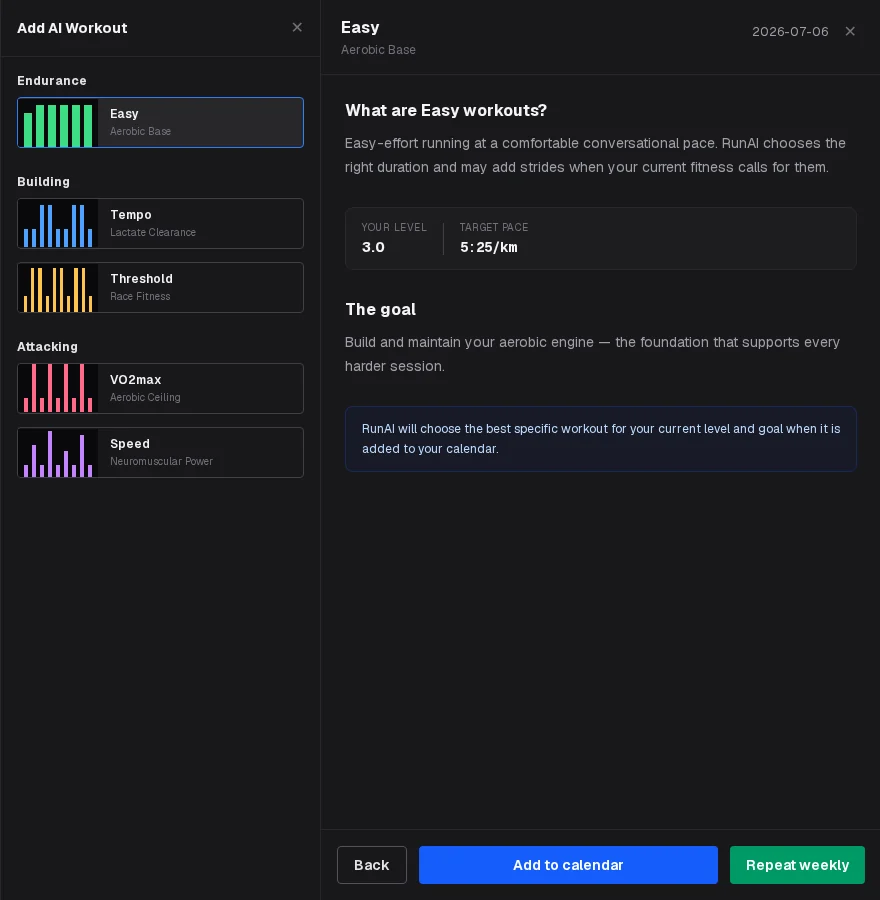
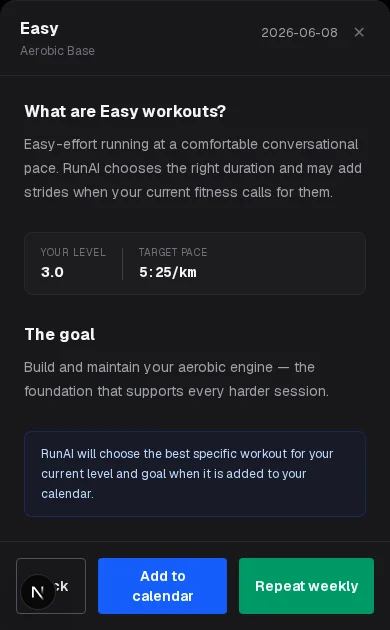
Workout detail explains the training goal and shows the athlete-relative level and target before it reaches the calendar.
The current calendar keeps the planned dose visible with duration, pace, category and RunAI provenance in one compact card.
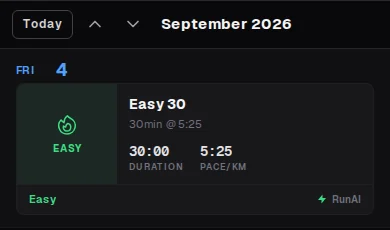
Real interface, demo data. These screens show current product behaviour; the forecast above remains explicitly experimental.
RunAI is being built to estimate how the training ahead may affect your fitness and goal trajectory, using your recent training, current capability, completed sessions and the exact work still on the calendar.
The prediction should move when the evidence moves. Change the training, miss a session, improve faster than expected or struggle with the planned dose, and the outlook should be recalculated.
Recent training, current levels, history and what has actually been completed.
Duration, intensity, workout type, progression and how those sessions fit together.
How fitness and goal progress may change if the plan is completed as expected.
Predictions are estimates. Confidence should improve as RunAI learns more about the athlete.
RunAI should not react to one magic readiness number. It should build a picture from the evidence you create every day — what you ran, how hard it felt, how your body feels and what is going on around the training.
The aim is not to avoid hard training. It is to choose the right hard training, at the right time, for the athlete in front of us.
Recent sessions feel appropriate and no new niggle is reported.
3 × 8 min controlled threshold effort stays on the calendar.
The illustrative outlook keeps the same direction because the evidence has not changed.
This interaction demonstrates RunAI's intended evidence → plan → outlook loop. The scenario and response are illustrative, not a validated prediction or medical recommendation.
Where it hurts, how severe it is and whether running changes it.
Recent load and how recovered you actually feel — not just what the calendar expected.
A session that felt much harder or easier than prescribed is new evidence.
Sleep, stress, soreness, illness and the context only you can report.
What you really did matters more than what was originally planned.
Life happens. The rest of the plan should respond instead of pretending it did not.
RunAI's Trophy Case is designed to recognise progress that normal running apps often miss. A faster interval is good. Repeating it for the first time is better evidence. A level upgrade, a new LT pace or a pain-free streak should feel like something happened.
The trophy is the celebration. The underlying training evidence is what matters.
First time repeating the pace
Capability moved forward
Prediction converted into progress
Training kept moving
Progress without forcing it
New durable distance
A year should tell a story: where you started, what improved, what interrupted training and how much stronger or more durable you became.
RunAI already has working product foundations. Forecasting and some direct device integrations are still being developed and validated, so they are labelled separately from live capability and external research.
Connect an athlete account and bring completed running activity into RunAI for the training loop.
Planned sessions can be created, changed and replanned as the athlete's calendar evolves.
Completed runs can capture effort and niggle feedback rather than treating a completed activity as the whole story.
The forecast is an estimate of likely direction from the athlete and training ahead — not a guaranteed race result or a validated accuracy claim. It should update as evidence and the plan change.
External studies help shape training rules. They do not prove RunAI's own predictive accuracy or athlete outcomes.
We are not publishing synthetic testimonials, athlete counts or performance-gain claims. Product outcomes need real beta evidence first.
RunAI uses connected training data and athlete-provided feedback to operate the product. Integration access can be disconnected from the athlete account.
RunAI is grounded in sports science and exercise-physiology research. We continuously review new evidence, use it to challenge our assumptions and update the product when better evidence emerges.
Where a recommendation depends on research, the goal is to make the evidence understandable and link back to the underlying studies — not hide behind jargon or vague claims of “AI”.
Training adaptation, endurance performance, injury risk, recovery and athlete monitoring.
Plain language first. No PMID soup dumped on the athlete.
Research informs the system; actual athlete response determines whether it works.
The model should get better rather than fossilise old assumptions.
A systematic review found that combining high-intensity intervals with continuous running can improve performance, VO₂max and running economy.
Read the study ↗A review of 48 studies found specific sprint training produced meaningful improvements across sprint distances.
Read the study ↗A review argues that appropriate progressive loading can build resilience, while rapid or poorly managed changes in load can increase risk.
Read the study ↗Strava is already connected and working. Direct Garmin, COROS and Apple Watch integrations are in progress.
Intervals.icu can also be used as a practical bridge for supported data during testing while the remaining direct integrations are built.
A normal plan mainly tells you what to do. RunAI is being built to understand the athlete, predict what planned training is likely to do, adapt when new evidence arrives, and make progress visible over time.
RPE means Rate of Perceived Exertion: simply how hard a workout felt to you. If a session that should feel manageable feels extremely hard, that is useful information the next plan decision should consider.
LT means lactate threshold. In plain English, it is the boundary around a hard but sustainable running intensity. RunAI uses threshold evidence to calibrate training paces and to detect meaningful improvements over time.
It combines completed training with athlete feedback such as pain or niggles, fatigue, RPE, Journal entries and missed or changed sessions. The aim is to reconsider what comes next instead of blindly following the original calendar.
Strava is already connected and working. Direct Garmin, COROS and Apple Watch integrations are still in progress. During early testing, Intervals.icu can also be used as a bridge for supported data where needed.
No app can promise that. RunAI is being designed to respond to pain, load and athlete feedback so training can be adjusted when the evidence suggests backing off or redirecting, with the goal of reducing avoidable risk while still progressing.
Research is not a badge on the website. We review relevant sports-science evidence, translate it into product rules, compare those rules with real athlete outcomes and update the system when better evidence emerges.
No. A forecast is an estimate based on the athlete and the training ahead. It should show uncertainty and change when the plan or athlete evidence changes.
Leave your name and email to hear about beta progress and opportunities to help shape RunAI. Pricing has not been announced yet.
After you submit, you'll only hear from us when there is a meaningful RunAI update or early-testing opportunity.